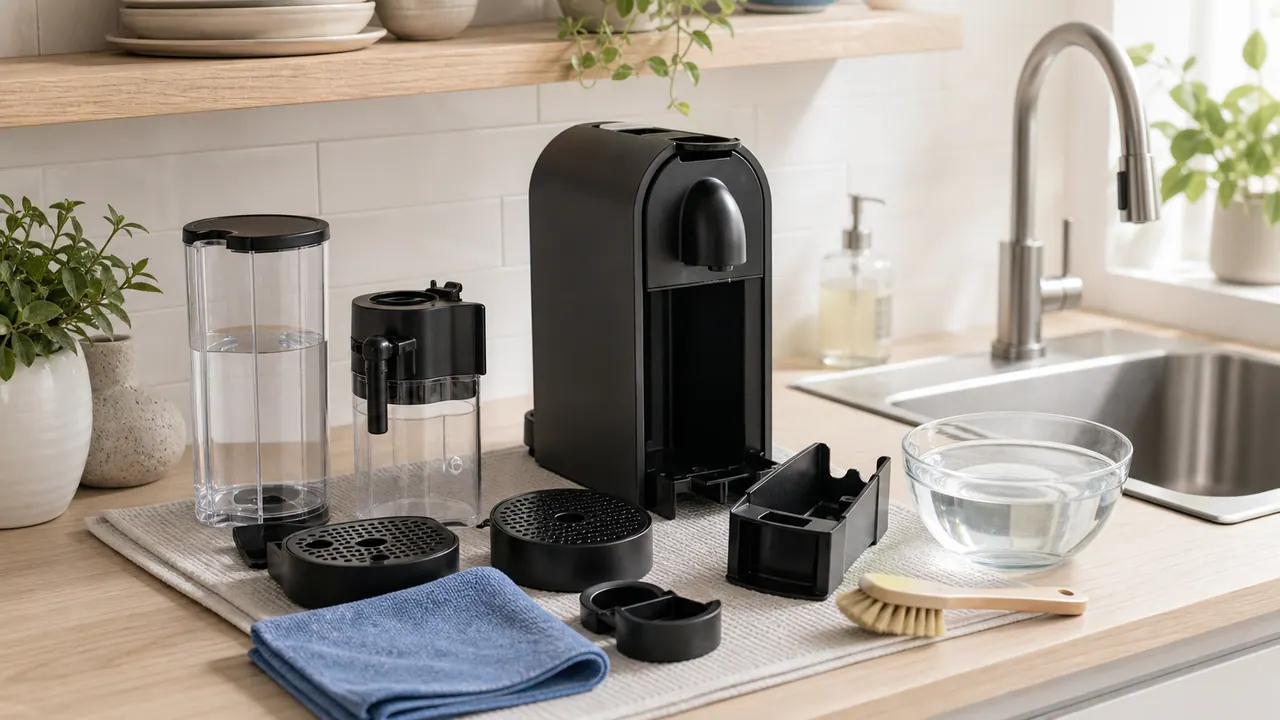
You can deep clean many visible and removable parts of a Nespresso machine without buying a special kit. What you cannot safely do without the right descaling product is remove internal limescale. Cleaning removes coffee oil, old water, loose grounds, and grime. Descaling removes mineral buildup inside the water circuit.
Use mild dish soap for removable parts, fresh water for rinsing, and a soft cloth for surfaces. Do not pour vinegar, bleach, scented cleaner, dishwasher detergent, or homemade acid mixes through the machine.
To deep clean a Nespresso machine without a kit, empty the capsule container and drip tray, hand-wash removable parts, wipe the capsule area gently, clean the coffee outlet exterior, rinse the water tank, run a water-only rinse if your model allows it, then dry everything before brewing. If the issue is slow flow, poor temperature, or a descaling alert, cleaning alone is not enough.
What you can clean without a kit
- Area
- Water tank
- What To Do
- Wash by hand, rinse well, air-dry
- What To Avoid
- Strong cleaners or dishwasher heat unless allowed
- Area
- Drip tray
- What To Do
- Empty, wash, dry
- What To Avoid
- Leaving old liquid under the cup support
- Area
- Capsule container
- What To Do
- Remove capsules, rinse residue
- What To Avoid
- Letting wet capsules sit for days
- Area
- Capsule area
- What To Do
- Wipe gently with a damp cloth
- What To Avoid
- Sharp tools or forcing the lever/head
- Area
- Coffee outlet
- What To Do
- Wipe outside and run water-only rinse
- What To Avoid
- Inserting objects into the spout
- Area
- Machine body
- What To Do
- Wipe with a soft cloth
- What To Avoid
- Spraying liquid into buttons or seams
Step-by-step: deep clean without a kit
1. Turn the machine off and let it cool
Switch the machine off and unplug it if you are cleaning around buttons or seams. Wait until the capsule area is cool, especially after several coffees.
2. Remove capsules and standing liquid
Open the machine normally and eject any used capsule. Empty the used capsule container and drip tray. Old coffee residue can smell stale even when the brewing system is fine.
3. Wash removable parts by hand
Wash the water tank, drip tray, capsule container, and cup support with warm water and a small amount of mild dish soap. Rinse until no soap smell remains. Soap left in the tank can affect the next cup.
4. Wipe the capsule chamber gently
Use a damp, soft cloth around the capsule entry area. For Nespresso Original, look for loose grounds or a crushed capsule edge. For Vertuo, keep the head area clean but do not scrape sensitive parts or force the mechanism.
5. Clean the coffee outlet exterior
Wipe the outside of the coffee spout with a damp cloth. If coffee is dried on, soften it with warm water on the cloth, then wipe again. Do not insert toothpicks, pins, knives, or brushes deep into the outlet.
6. Run a water-only rinse
Refill the tank with fresh water. Place a large cup under the outlet and run a rinse or water-only cycle if your model supports it. Do not guess hidden button combinations; check the manual for model-specific cleaning modes.
If the first rinse is cloudy or carries old coffee particles, run one more water-only rinse. If several rinses remain dirty, stop and investigate residue, capsule issues, or overdue maintenance instead of improvising a chemical flush.
8. Dry, reassemble, and test
Dry the outside, replace every part firmly, and brew a water-only cup or a normal capsule depending on your model. If the coffee tastes normal and flow is steady, the clean worked.
When cleaning without a kit is not enough
A no-kit clean does not remove internal limescale. If the machine shows a descaling alert, brews slowly, makes cooler coffee than usual, or struggles in a hard-water area, plan a proper descale with the recommended product for your machine.
Original and Vertuo machines use different capsule systems and cleaning signals. Original machines may have espresso/lungo buttons or milk-system parts. Vertuo machines may use a single main button, head lock, barcode-based capsules, and different rinse signals. Do not assume the same button sequence works across systems.
The biggest mistake is using “deep clean” to mean “descale.” Another is pouring vinegar or random cleaner into the water tank because no kit is available. Also, do not ignore the drip tray and capsule container; much visible grime starts there. If a capsule or lever is stuck, never force it.
Can I deep clean a Nespresso machine without a kit?
Yes, you can clean removable parts, visible residue, the water tank, drip tray, capsule container, and run water-only rinses. You cannot properly descale internal limescale without the right descaling product.
Can I use vinegar instead of a descaling kit?
Avoid it. Vinegar can leave odor and may not be suitable for internal machine materials.
Should I put Nespresso parts in the dishwasher?
Do not assume. Some removable parts may be hand-wash only. Check your model manual before using a dishwasher.
Does cleaning fix slow coffee flow?
Sometimes, if residue or a blocked outlet is the issue. If slow flow continues, descaling or official support may be needed.