
That shared base is the important part. Both machines use a Thermocoil heater with PID temperature control, a 15-bar pump with low-pressure pre-infusion, a 54 mm portafilter, an 8.8 oz (250 g) bean hopper, a 67 fl oz (2 L) removable tank, an espresso pressure gauge, a dedicated hot-water outlet and the same kind of 360° swivel manual steam wand. Neither one steams milk for you.
So the real question is narrow: is the step between grinding and brewing worth paying more for? The Impress sits above the standard Express in Breville's range, and the gap changes with retailer promotions, so check both cards below before deciding.
If you have not settled on a Breville yet, the Barista Express review covers the standard machine in depth, Bambino Plus vs Barista Express weighs a separate grinder, and Ninja Luxe Café vs Barista Express looks at a more guided alternative.
What actually changes between BES870XL and BES876
Dosing
- Barista Express BES870XL
- GRIND AMOUNT dial sets grind time; you judge the level in the basket
- Express Impress BES876
- Intelligent dosing calculates the dose from the last grind; dose-level gauge after each tamp
Correcting a dose
- Barista Express BES870XL
- Grind more by hand or trim with the Razor tool
- Express Impress BES876
- "A Bit More" top-up for an under-dose; Razor trim for an over-dose; next dose auto-corrects
Tamping
- Barista Express BES870XL
- Integrated removable tamper; you lift the portafilter out and tamp by hand
- Express Impress BES876
- Assisted lever: 22 lb (10 kg) tamp with a 7° twist finish, portafilter stays in the cradle
Grind settings
- Barista Express BES870XL
- 16
- Express Impress BES876
- 25
Heating, pump, pressure
- Barista Express BES870XL
- Thermocoil, PID, 15-bar pump, low-pressure pre-infusion
- Express Impress BES876
- Same: Thermocoil, PID, 15-bar pump, low-pressure pre-infusion
Milk
- Barista Express BES870XL
- Manual 360° swivel steam wand
- Express Impress BES876
- Manual 360° swivel steam wand
Hopper and tank
- Barista Express BES870XL
- 8.8 oz (250 g) hopper, 67 fl oz (2 L) tank
- Express Impress BES876
- 8.8 oz (250 g) hopper, 67 fl oz (2 L) tank
Size (W × D × H)
- Barista Express BES870XL
- 15.9 × 13.1 × 12.4 in
- Express Impress BES876
- 16.6 × 14.4 × 12.2 in
Specifications from Breville's US product pages and instruction books. More grind settings and assisted tamping change the workflow; they are not a taste score.
US comparison of the Barista Express BES870XL and Barista Express Impress BES876, reviewed November 16, 2026, from Breville's US product pages and US/Canada/Mexico instruction books. It is a workflow and buying assessment; we did not run a hands-on taste, speed, noise or reliability test. Barista Pro, Barista Touch and Touch Impress are different machines.
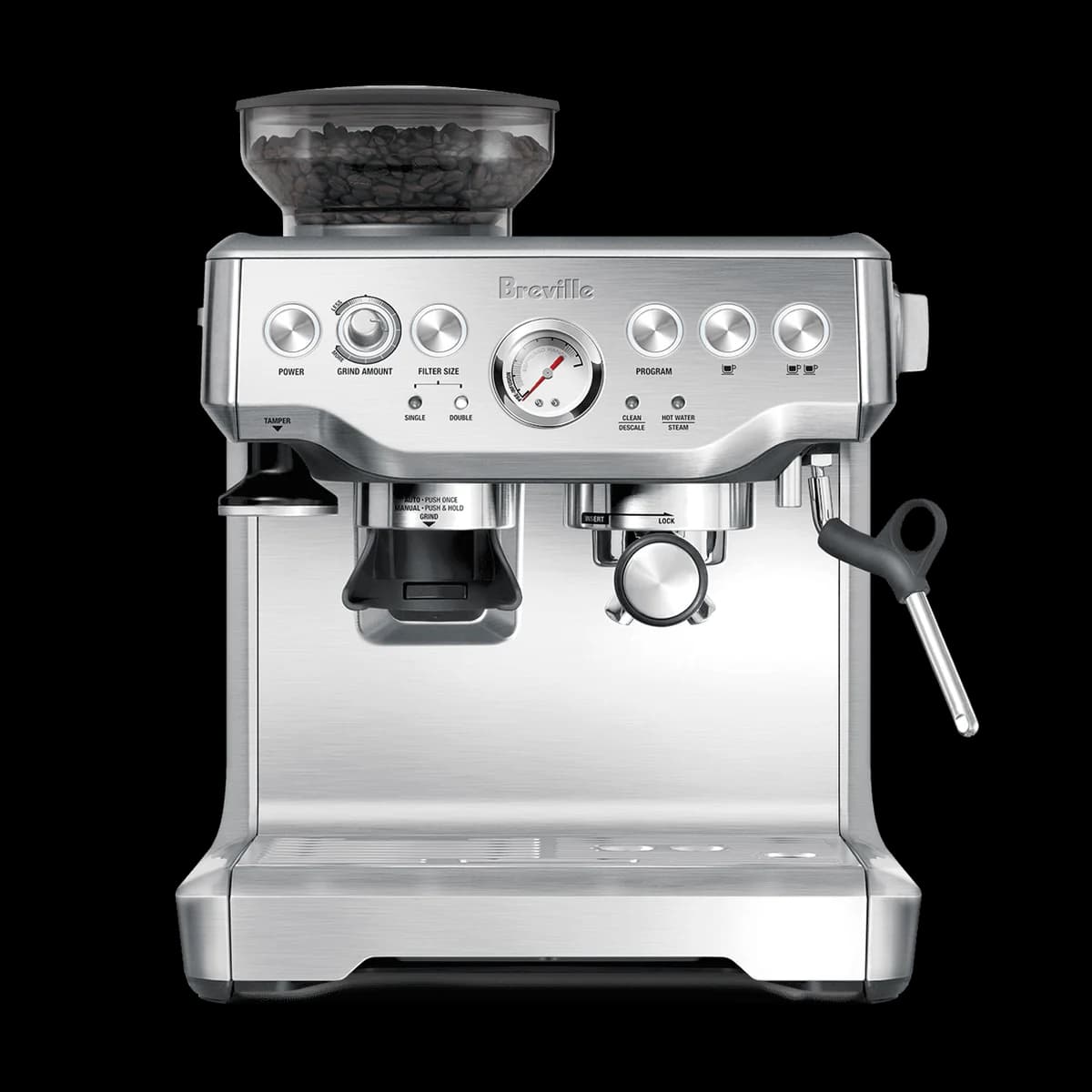
Barista Express BES870XL: the same machine, with you as the tamper
On the standard Express you twist the dosing funnel onto the portafilter, push it into the cradle and let the grinder run for the time set on the GRIND AMOUNT dial. You then lift the portafilter out, tap it to settle the grounds and tamp with the integrated tamper. Breville's manual suggests roughly 22 to 33 lb of pressure and says consistency matters more than the exact number.
There is no feedback on whether the dose was right until you brew. The manual's guide is visual: after tamping, the metal cap on the tamper should sit level with the top of the basket. If the dose is high, the Razor tool trims it; if it is low, you grind a little more. The grind dial controls time, not weight, so changing grind size also changes how much coffee lands in the basket.
None of that is a flaw for the right owner. It is exactly what you learn on any manual espresso setup, and the skills carry over if you later move to a separate grinder and machine. If you want to understand why a shot runs fast or slow, the standard Express keeps every variable in your hands.
WhichCapsule note: This card is the standard BES870XL in brushed stainless steel. Check the model code on any listing: the Impress and other Barista models sit close to it in search results.
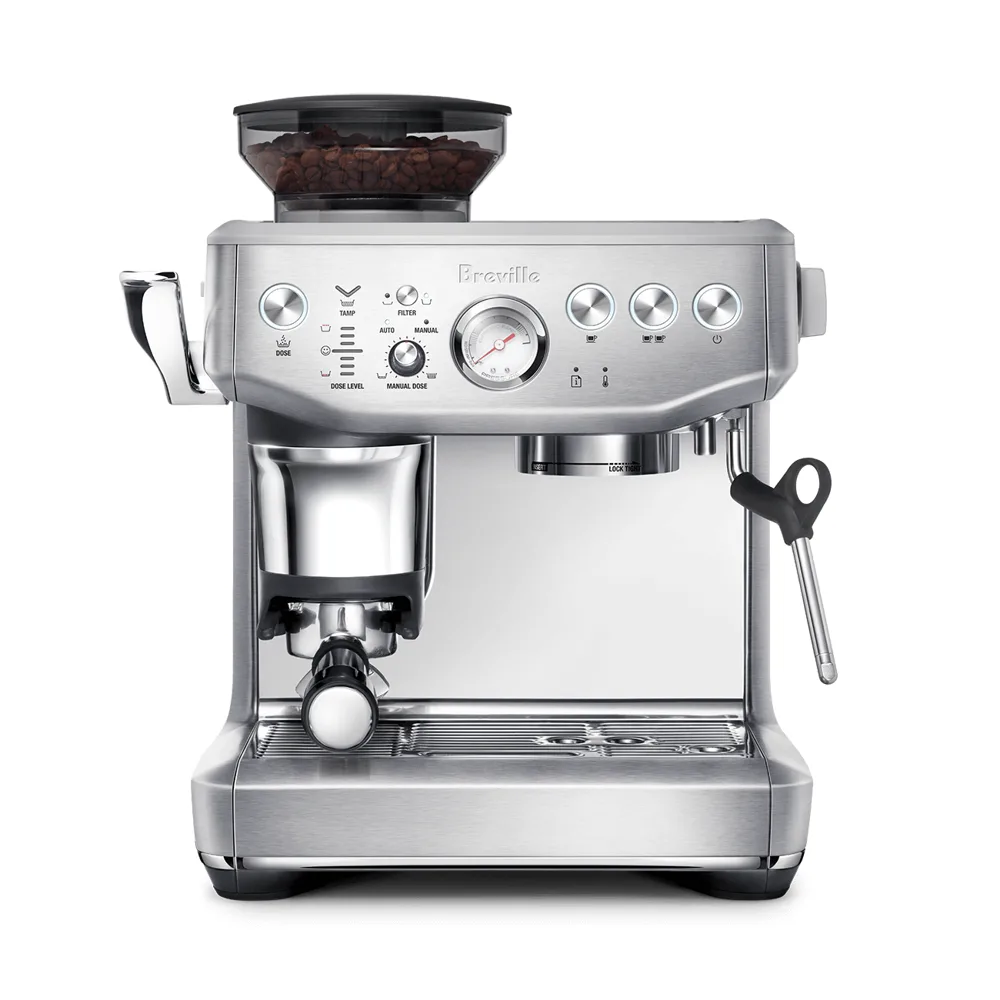
Express Impress BES876: dose feedback and an assisted tamp
The Impress Puck System replaces the funnel-and-tamp routine. You press Dose, the grinder fills the basket while the portafilter stays in the cradle, then you pull the tamp lever down until it beeps. Breville rates the tamp at 22 lb (10 kg) with a 7° twist finish, and the manual recommends tamping twice for a polished puck.
After the tamp, a dose-level gauge shows whether the basket is under, ideal or over. An under-dose flashes the Dose button so you can add "A Bit More"; an over-dose is trimmed with the Razor tool. Either way the machine adjusts the grind time for the next shot. A manual dose mode is there if you want to set the amount yourself.
The Impress also offers 25 grind settings against the Express's 16, which gives finer steps when you change beans. Be realistic about what it does not do: it does not weigh coffee, it does not judge the shot for you, and it does not texture milk. When you change grind size, the manual notes the new auto-dose time is only calculated after your next tamp, so the first shot after an adjustment may need a top-up or a trim.
WhichCapsule note: Brushed-stainless-steel US BES876. Breville sells other finishes; confirm the model code and that the listing is new, not refurbished.
A weekday latte, step by step on each machine
Dose: on the Express, fit the funnel, grind, then look at the basket and decide whether it is right. On the Impress, press Dose and read the gauge after tamping. If you make one drink a day with the same beans, the Express quickly becomes routine; if beans or drinkers change often, the Impress's feedback and auto-correction do more work.
Tamp: on the Express, remove the portafilter, tap, tamp, remove the funnel and wipe the rim. On the Impress, the portafilter stays in the cradle while you pull the lever, and Breville presents that as less mess on the drip tray and counter. Brewing and steaming are then identical: same group head, same pre-infusion, same manual wand, same jug to clean.
Cleanup: both leave a wet puck to knock out, a basket to rinse, a steam wand to purge and wipe, and the same cleaning-tablet and descaling cycles. The Impress adds one job of its own: the manual has you remove the tamp cover and brush the tamp face, cradle and grinder chute. The Express's separate tamper and funnel are simply extra loose tools to rinse and store.
WhichCapsule note: A workflow description from the two instruction books, not a timed comparison. Neither machine is faster on paper for a full milk drink.
Compare buying options
Paid links. Prices can change; the price at checkout applies.
Who should pay more for the Impress
Pay the difference if more than one person makes coffee and you want them to get a consistent puck without teaching everyone to judge a dose. The gauge gives a shared reference, and the lever removes the variable most newcomers get wrong.
Pay it, too, if you have wrist or grip discomfort with a hand tamper, or if you know you will skip the funnel and wipe-down on rushed mornings. And if you change beans often, the extra grind steps and automatic dose correction reduce the fiddling each bag brings.
Keep the money if you enjoy the hands-on part, live alone with one regular bean, or plan to move to separate equipment later. The Impress also has a slightly larger footprint, 16.6 × 14.4 in against 15.9 × 13.1 in, so measure the depth if your counter is shallow. Spending the difference on a scale or a knock box may help the standard Express more than the upgrade would.
WhichCapsule note: The two cards show the machines compared here. Look at both current prices before deciding, as the difference is not fixed.
Naming traps before you order
Breville's US range has several close names. The Barista Express is BES870XL. The Barista Express Impress is BES876. The Barista Pro and Barista Touch change the heating system and controls, and the Barista Touch Impress is a separate, touchscreen Impress model. In the UK, the same machines are sold under the Sage brand with different model codes.
Both machines include single- and dual-wall baskets, a stainless milk jug, the Razor trimming tool, a water filter and cleaning tools. The Express also comes with the Dosing Funnel and integrated tamper; the Impress has the tamping system built in instead. Check what the specific listing includes, because bundles and promotions vary by seller.
What people actually ask
What is the main difference between the Barista Express and the Express Impress?
Dosing and tamping. The Express Impress BES876 has intelligent dosing, a dose-level gauge and an assisted tamp lever that applies 22 lb with a 7° twist. The standard Barista Express BES870XL uses a timed grind dial and a tamper you press by hand. Heating, pump, steam wand, hopper and tank are the same.
Does the Express Impress make better espresso?
Breville does not claim a different extraction system: both machines use Thermocoil heating, PID control, low-pressure pre-infusion and a 15-bar pump. The Impress makes a consistent dose and tamp easier to repeat. It does not change what happens in the group head, and we have not run a taste test.
Does the Express Impress weigh the coffee?
No. It calculates the next dose from the result of the last grind and tamp and shows the level on a gauge. Neither machine has a built-in scale; use a separate scale if you want to dose by weight.
Is the Express Impress steam wand automatic?
No. Both machines have the same kind of manual 360° swivel steam wand. You position the jug and judge texture and temperature yourself.
How many grind settings does each machine have?
The Barista Express BES870XL has 16 grind settings and the Express Impress BES876 has 25, according to Breville's US product pages and manuals.
Is the Express Impress bigger?
Slightly. Breville lists the Impress at 16.6 × 14.4 × 12.2 in and the Express at 15.9 × 13.1 × 12.4 in (W × D × H). The extra depth matters most on shallow counters or under cabinets with little room behind the machine.
Is the Impress harder to clean?
It is different rather than harder. Both need the puck knocked out, the basket rinsed, the steam wand purged and the same cleaning and descaling cycles. The Impress adds brushing the tamp face, cradle and chute under a removable cover; the Express has a loose tamper and funnel to rinse and store.
Who should buy which version
- Choose the Barista Express BES870XL if you want to learn dosing and tamping by hand and would rather keep the price difference.
- Choose the Express Impress BES876 if several people share the machine, you dislike hand tamping, or you want feedback on every dose.
- Choose neither if you want milk handled for you; both have a manual steam wand, so look at a guided machine instead.
The bottom line
I would buy the standard Barista Express for someone who sees learning espresso as part of the fun: the brewing hardware is the same, and the skills it teaches are the ones every manual setup asks for. I would buy the Express Impress for a household where several people make coffee, or for anyone who knows the funnel, the hand tamp and the guesswork are what will stop them using the machine.
Before you pay more, be specific: if the dose and tamp step is not the part you expect to struggle with, the Impress mostly adds convenience to a machine that otherwise works exactly like the one beside it.