
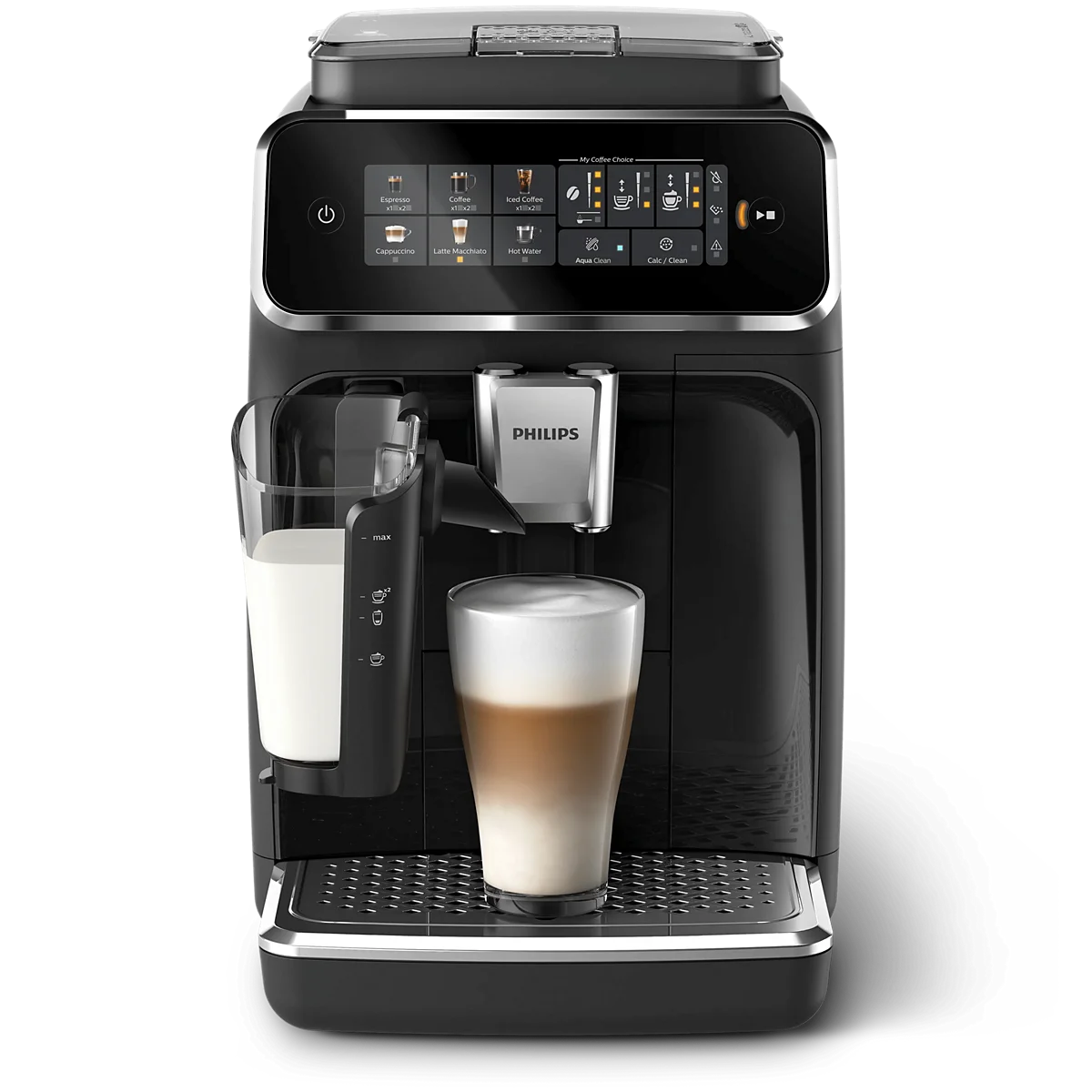
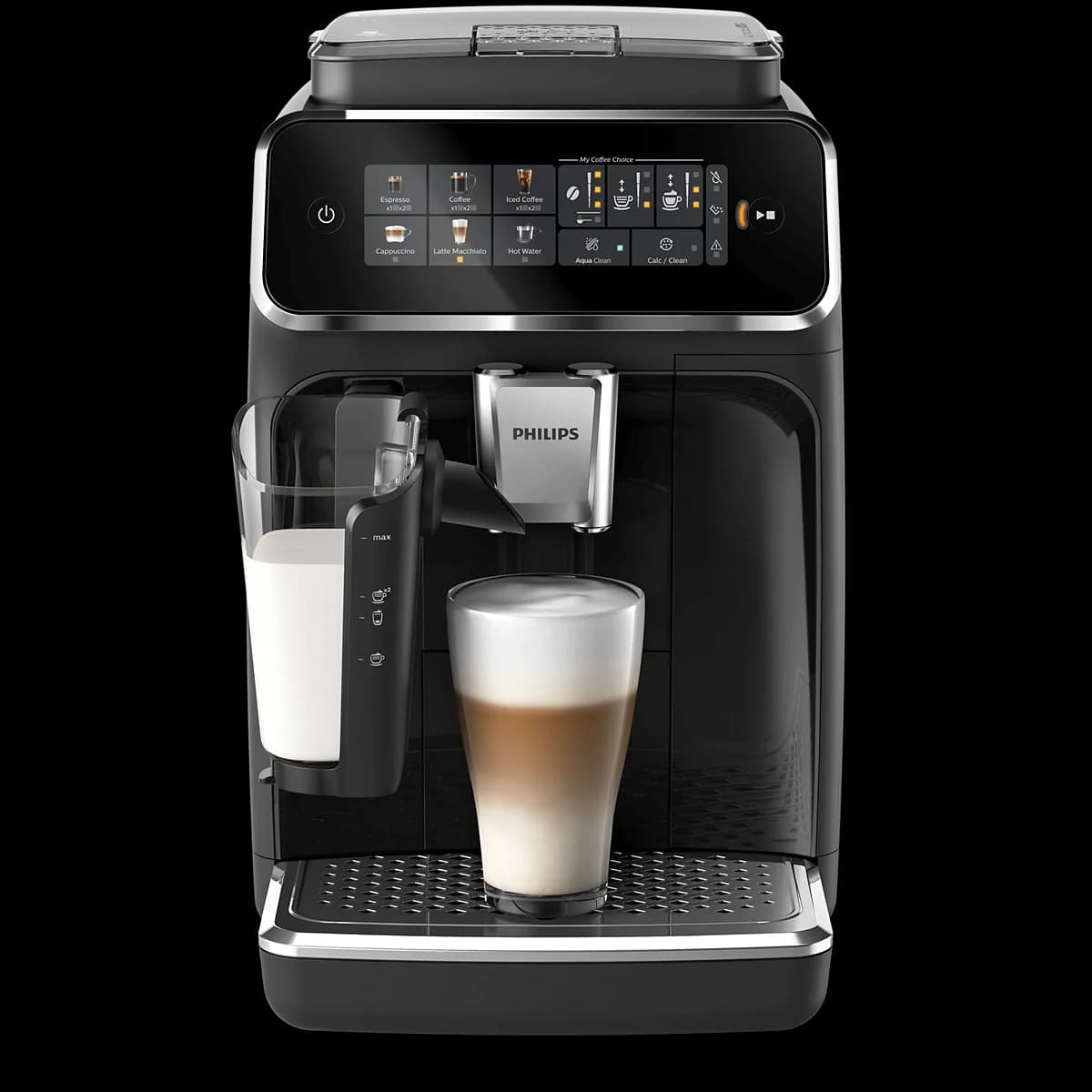
It is a fully automatic machine: it grinds, tamps, brews and drops the used grounds into an internal bin. There is no portafilter to handle. You still fill beans and water, empty the grounds and drip tray, and follow the weekly and monthly care schedule.
The upgrade question is the Philips 5500. Most households do not need it. Buy the 5500 only if several people want their own saved recipes or you will regularly use drinks the 3300 does not have, such as Americano, flat white or iced latte.
Philips 3300 LatteGo EP3341/50 at a glance
Drinks
- EP3341/50 detail
- Espresso, coffee, cappuccino, latte macchiato, iced coffee and hot water
- What it means day to day
- Covers the usual weekday menu with one-touch buttons
Grinder
- EP3341/50 detail
- Ceramic grinder, 12 settings
- What it means day to day
- Set it once for your beans; adjust strength and quantity per drink
Milk
- EP3341/50 detail
- LatteGo: two-part container, no milk tubes
- What it means day to day
- Rinse or put in the dishwasher after use; quick to reassemble
Brew unit
- EP3341/50 detail
- Removable brew group
- What it means day to day
- Rinse weekly; coffee-oil remover monthly as the manual directs
Profiles
- EP3341/50 detail
- No separate user profiles
- What it means day to day
- People share drink settings; the 5500 adds saved profiles
Iced
- EP3341/50 detail
- Iced coffee recipe
- What it means day to day
- Coffee brewed over ice, not a cold-brew program
Features from Philips’ US EP3341/50 page and manual. A drink count is not a taste score.
US review written November 15, 2026, from Philips product pages, the US comparison chart and the 2300/3300 manual. It covers EP3341/50 Glossy Black; other 3300 suffixes such as EP3347/90 are different variants. It is a buying and workflow assessment; we did not run our own taste, speed, noise or reliability test.
Why LatteGo is the reason to buy it
Most automatic milk systems run milk through a tube and a carafe lid with several small parts. LatteGo is a container and a frame that separate in one motion. After your last milk drink, rinse it or put it in the dishwasher, and you are done. That is the cleaning step people skip on other machines, and skipping it is what makes milk systems smell.
The trade-off is that you add milk for each round rather than storing a full carafe in the fridge. For one or two milk drinks a day, that is an easy trade. For someone who wants a carafe ready for repeated drinks, a carafe system may suit better; compare the De’Longhi in our Magnifica Evo review.
Make two cappuccinos as consecutive drinks: brew the first, move the cup, brew the second, then wash LatteGo once. Do not expect two milk drinks at the same time from a two-cup function.
WhichCapsule note: This is EP3341/50 in Glossy Black. EP3347/90 and other suffixes are different variants with their own listings.
What you still have to do
Every few days: empty the grounds bin and drip tray, refill water and beans. Weekly: remove and rinse the brew group. Monthly, according to the manual: run the coffee-oil remover treatment, with lubrication handled separately based on use. Descaling depends on your water hardness and whether you use the water filter.
None of this is hard, but it is not optional. A bean-to-cup machine replaces the portafilter work of a manual machine with a few minutes of maintenance each week. If you will not do the weekly brew-group rinse, no automatic machine will stay pleasant to use.
A water filter extends the time between descaling under Philips’ stated conditions. It does not wash the milk parts, empty the grounds or clean coffee oils.
WhichCapsule note: The manual’s cleaning table is the authority for products, timing and safe removal of the brew group.
3300 or 5500: do you need the upgrade?
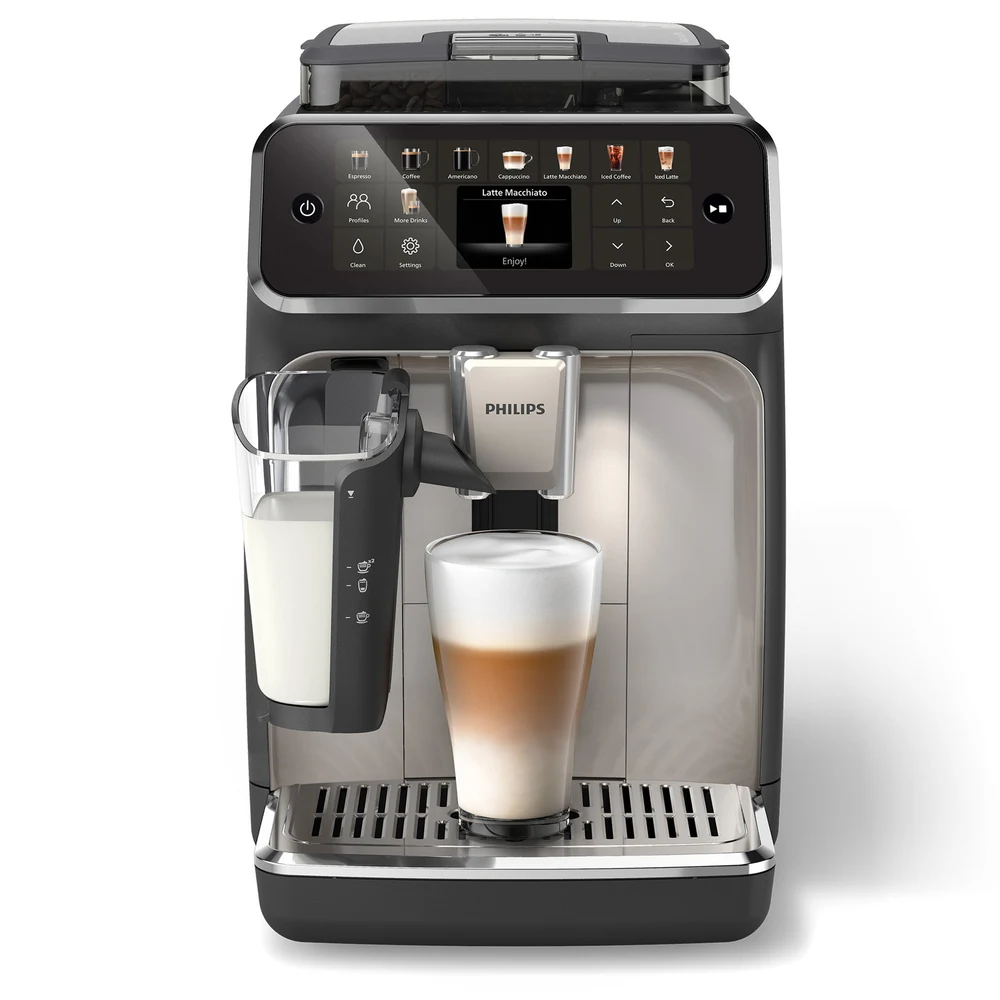
The Philips 5500 LatteGo EP5544/94 uses the same milk system and adds a larger drink menu, including Americano, flat white and more iced recipes, plus four saved user profiles and a guest mode. It also has ExtraShot, which adds an extra ristretto to a selected drink.
Profiles solve one specific problem: two people who want different versions of the same drink and keep overwriting each other’s settings. If everyone in the house is happy with one cappuccino recipe, they add little. Profiles also share the same beans, grinder and milk container.
Write down the drinks your household made last week. If they fit the 3300’s six, buy the 3300. If the list includes Americanos, flat whites or competing recipes, the 5500 earns its place. Our 3300 vs 5500 comparison walks through that list in detail.
WhichCapsule note: This is the US EP5544/94 in Gray Chrome. Check the model code before ordering.
View this model
Paid links. Prices can change; the price at checkout applies.
Philips 3300 vs De’Longhi Magnifica Evo
The De’Longhi Magnifica Evo ECAM29084SB is the closest rival at this level. It has seven recipes, including My Latte, a 13-setting conical burr grinder and a LatteCrema milk carafe with an automatic rinse prompt. The carafe has more parts to wash thoroughly than LatteGo.
Choose the Philips if easy milk cleanup is your priority. Choose the De’Longhi if you prefer a carafe and its My Latte recipe. Philips 3300 vs Magnifica Evo compares their cleaning routines side by side.
WhichCapsule note: The Magnifica Evo card is on our De’Longhi review; this page keeps its cards to the 3300 and 5500.
Coming from a pod machine?
The 3300 is the most natural step up from capsules if you want fresh beans without learning espresso technique. The trade is a weekly maintenance routine instead of disposing of used capsules. If you are deciding between this and a Nespresso milk machine, Philips 3300 vs Gran Lattissima follows the same drinks through both.
Buying it on Amazon
Check the model codes EP3341/50 and EP5544/94 on the listing. Sellers, finishes and bundles change, so confirm the model code, condition and included items before ordering. Promotions on Philips’ own store are not automatically included with an Amazon purchase.
View this model
Paid links. Prices can change; the price at checkout applies.
What people actually ask
Is the Philips 3300 LatteGo easy to clean?
The milk system is: LatteGo is two parts with no tubes and can be rinsed or washed in the dishwasher. The machine still needs a weekly brew-group rinse, a monthly coffee-oil treatment per the manual, and regular emptying of the grounds bin and drip tray.
What drinks does the Philips 3300 make?
Espresso, coffee, cappuccino, latte macchiato, iced coffee and hot water. It has no dedicated Americano or flat white button; the 5500 adds those.
Philips 3300 vs 5500: which should I buy?
Buy the 3300 if its six drinks cover your routine and shared settings are fine. Buy the 5500 if several people want saved profiles or you regularly drink Americanos, flat whites or iced lattes.
Does the Philips 3300 make cold brew?
No. Its iced coffee recipe brews coffee over ice. That is a different method from a long cold-water steep.
Are EP3341/50 and EP3347/90 the same machine?
They are different Philips 3300 variants with different finishes and listings. This review and its card are for EP3341/50 Glossy Black on Amazon US.
Should you buy the Philips 3300?
- Buy the 3300 if you want one-touch milk drinks from beans and the easiest milk cleanup.
- Buy the 5500 if several people want saved recipes or a bigger drink menu.
- Buy a portafilter machine instead if you want to learn espresso and steam milk yourself.
The bottom line
The Philips 3300 LatteGo is the bean-to-cup machine I would point most first-time buyers to. Its menu covers what most households drink, and LatteGo makes the milk cleanup quick enough that people actually do it.
Buy the 5500 only when profiles or extra drinks solve a real problem in your house. Otherwise the 3300 is the better buy.
Choose your buying option
Paid links. Prices can change; the price at checkout applies.